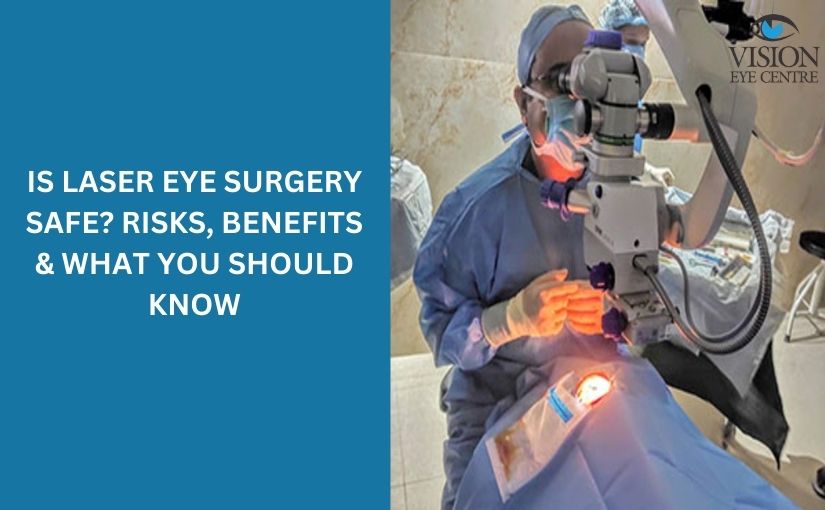
Is Laser Eye Surgery Safe? Risks, Benefits & What You Should Know
Mar 17, 2026
Is Laser Eye Surgery Safe? Risks, Benefits & What You Should Know
If you've spent years reaching for your glasses every morning or wrestling with contact lenses, the idea of laser eye surgery is understandably appealing. But the question most people ask before taking the plunge is: Is it actually safe?
The short answer is — yes, for the right candidates and in experienced hands, laser eye surgery is one of the safest elective surgical procedures available today. But like any medical procedure, it comes with considerations you should understand fully before deciding.
[IMAGE: A patient undergoing LASIK laser eye surgery with a medical professional at the machine]
What Is Laser Eye Surgery?
Laser eye surgery is a group of refractive procedures that use precise laser technology to reshape the cornea — the clear front surface of the eye — so that light focuses correctly on the retina. The result? Clear vision, often without the need for glasses or contacts.
The most common types include:
- LASIK (Laser In Situ Keratomileusis) – The most widely performed. A flap is created in the cornea and reshaped with a laser.
- LASEK / PRK (Photorefractive Keratectomy) – The surface layer is treated directly. Takes longer to recover but has no flap complications.
- SMILE (Small Incision Lenticule Extraction) – A minimally invasive, flapless option gaining popularity.
Is Laser Eye Surgery Safe? What the Numbers Say
Modern laser eye surgery has an impressive track record. Studies consistently show:
- LASIK success rate: 96–99% of patients achieve 20/20 vision or better.
- The procedure itself takes less than 15 minutes per eye.
- Serious complications are rare, occurring in fewer than 1% of procedures.
- The technology has improved dramatically in the last decade with wavefront-guided and bladeless systems.
That said, safety depends heavily on patient selection, surgeon expertise, and the technology used.
[IMAGE: Infographic showing LASIK success statistics and patient satisfaction rates]
Who Is a Good Candidate for Laser Eye Surgery?
Not everyone is suitable for laser eye surgery. A thorough pre-operative evaluation is essential. You may be a good candidate if:
- You are 18 years or older (ideally 21+)
- Your prescription has been stable for at least 1–2 years
- Your corneas are of adequate thickness
- You do not have dry eye disease, keratoconus, or certain autoimmune conditions
- You are not pregnant or breastfeeding
Learn about our comprehensive eye examination and consultation process
Benefits of Laser Eye Surgery
Freedom from Glasses and Contacts
The most obvious benefit — most patients no longer need corrective eyewear for daily activities after surgery.
Long-Lasting Results
For the majority of patients, the results are permanent. While vision can change slightly with age, the correction achieved by the laser is enduring.
Fast Recovery
LASIK patients often notice improved vision within 24 hours. Full recovery typically takes 1–4 weeks depending on the procedure type.
Improved Quality of Life
Sports, travel, and daily activities become significantly easier without the hassle of glasses or contact lenses.
Risks and Side Effects of Laser Eye Surgery
Common Temporary Side Effects
- Dry eyes (most common side effect, usually temporary)
- Glare, halos, or starbursts around lights at night
- Sensitivity to light
- Slight blurring during the healing phase
Less Common Complications
- Undercorrection or overcorrection (may require a secondary procedure)
- Regression of vision over years, particularly in high prescriptions
- Flap complications (specific to LASIK, rare with experienced surgeons)
- Infection or inflammation (very rare with proper post-op care)
Rare but Serious Risks
- Corneal ectasia — progressive weakening of the cornea. Rare and largely preventable with proper screening.
- Significant vision loss — extremely uncommon with modern techniques.
[IMAGE: Diagram of the eye showing the cornea and how laser reshaping works]
Find out if your eye power can be reduced without surgery
Questions to Ask Before Choosing Laser Eye Surgery
- What type of laser surgery is best for my prescription and corneal thickness?
- What technology does the clinic use (wavefront-guided, bladeless, SMILE)?
- What is the surgeon's experience and complication rate?
- What does the post-operative care include?
- Am I fully informed about the alternatives?
Laser Eye Surgery vs Glasses: Is It Worth It?
For most candidates, the long-term convenience and cost savings of eliminating glasses and contacts outweigh the one-time cost and minor risks of surgery. However, the decision is personal and should be made after a thorough consultation with a qualified ophthalmologist.
Book a laser eye surgery consultation with our specialists
Frequently Asked Questions
Q: How long does laser eye surgery last?
A: For most patients, the results of laser eye surgery are permanent. However, natural age-related vision changes (such as presbyopia) can still develop over time and may require reading glasses later in life.
Q: Does laser eye surgery hurt?
A: The procedure itself is virtually painless. Anaesthetic eye drops are used beforehand. Some patients experience mild discomfort, sensitivity, or a gritty sensation in the days following surgery, which typically subsides quickly.
Q: What is the minimum age for laser eye surgery?
A: Most surgeons recommend waiting until at least 18–21 years old, and until the prescription has been stable for 1–2 years, as younger eyes may still be changing.
Q: Can laser eye surgery correct all types of vision problems?
A: LASIK and similar procedures can correct myopia (short-sightedness), hyperopia (long-sightedness), and astigmatism. They are not designed to treat age-related long-sightedness (presbyopia), though monovision LASIK can help.
Q: What happens if I move my eye during laser surgery?
A: Modern laser systems use advanced eye-tracking technology that follows eye movements in real time and automatically adjusts the laser's position. There is no risk of the laser "missing" due to small involuntary movements.
Take the First Step Towards Clear Vision
If you're tired of glasses and want to explore whether laser eye surgery is right for you, the best starting point is a comprehensive eye evaluation with a specialist.
Explore our laser eye surgery options and success stories
Book your consultation today and find out if you're a suitable candidate for laser eye surgery.
Contact our ophthalmology team
Medical Disclaimer: This article is for informational purposes only. Individual results vary. Please consult a qualified ophthalmologist before making any decisions about eye surgery.